Why RMC is Better Than Site-Mixed Concrete for Industrial Projects
On a steel plant site or a large commercial foundation, the quality of concrete is not negotiable. Yet many projects still rely on site-mixed concrete — a practice that introduces variability at exactly the moment precision matters most.
The Problem with Site-Mixed Concrete on Industrial Sites
Site-mixed concrete depends on manual measurement of materials, water addition by feel, and mixing equipment that is rarely calibrated. On a small residential project, the consequences of inconsistency are manageable. On an induction furnace foundation or a CCM equipment base, they are not.
Variables that go uncontrolled in site mixing include the water-cement ratio, aggregate grading, admixture dosing and mixing duration. Each one affects compressive strength, workability and long-term durability. When any one of these is off, the structure can suffer — and with industrial loads, that matters.
What Ready Mix Concrete Changes
Ready mix concrete is produced in a controlled plant environment where every ingredient is weighed, not estimated. The mix design is engineered for the specific structural requirement — whether that is M20 for a support building or M50 for a machine foundation under dynamic load.
- Water-cement ratio is precisely controlled — eliminating the single biggest cause of weak concrete
- Aggregate is graded to specification before batching — consistent particle size, consistent strength
- Admixtures (plasticisers, retarders, accelerators) are dosed to exact quantities
- Mixing is mechanical, timed and complete before dispatch
- Each batch is traceable — production records exist for every pour
Speed on Site
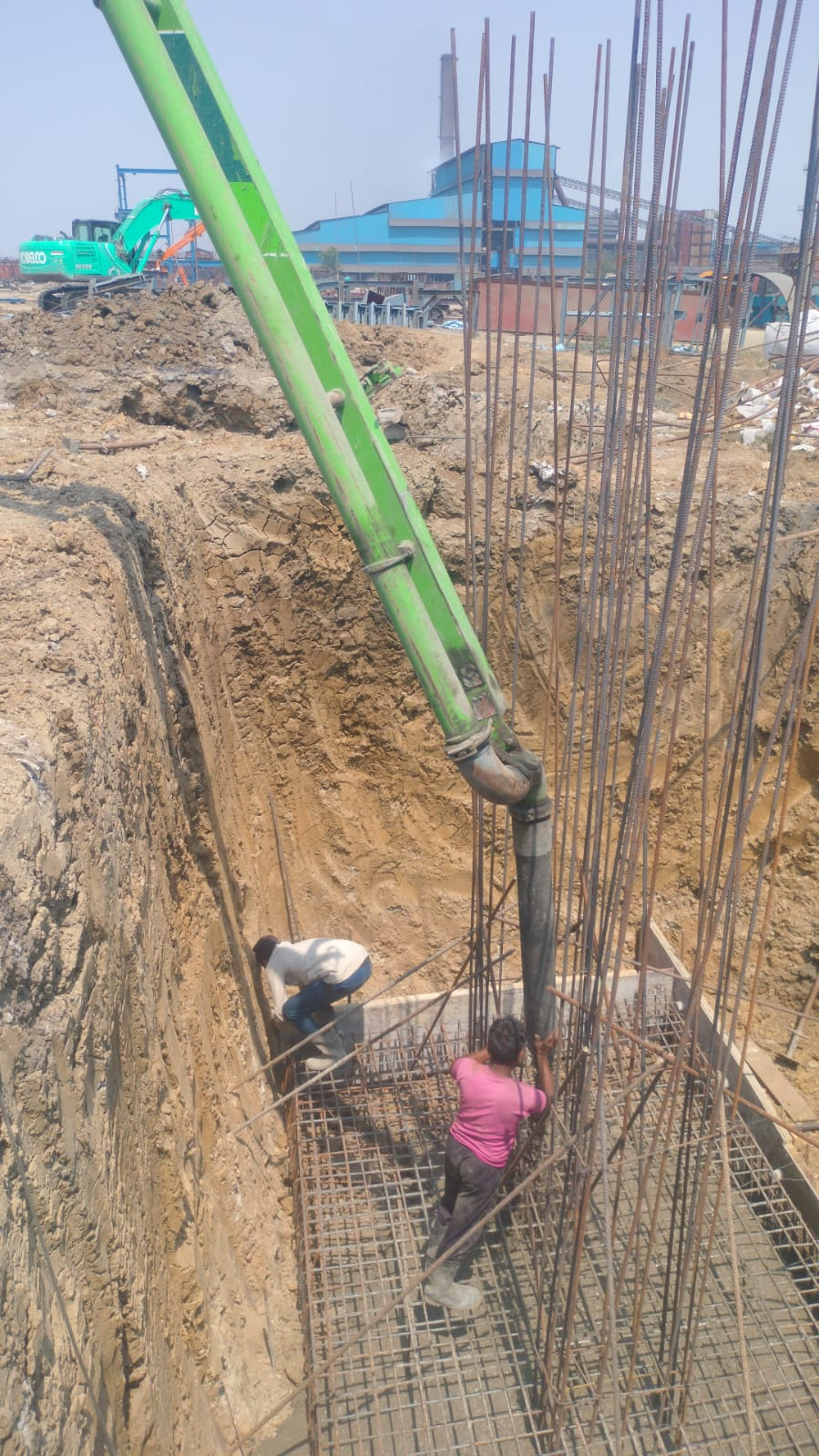
RMC also changes the pace of work. When concrete arrives by transit mixer, the site team focuses on placement, compaction and finishing — not batching. Large pours that would take a day to execute by site mixing can be completed in a few hours with pump and transit mixer combination. This matters enormously on industrial sites where shutdowns are measured in hours.
The Ultratech Difference at KKB Group's Jalna Plant
KKB Group's RMC plant at Tandulwadi, Bhokardan Road, Jalna is operated under a long-term agreement with Ultratech Cement Ltd. — India's largest cement company. This means every batch produced follows Ultratech's mix design protocols, quality assurance processes and production standards.
For industrial clients in and around Jalna, this is a significant advantage: the institutional quality control of a national cement company, available from a local plant with on-site delivery capability.
When to Use RMC
- Machine foundations subject to vibration or dynamic loading
- Large raft or mat foundations where consistency across a single pour is critical
- Projects with tight timelines where batching time cannot be afforded
- Structural elements where strength certification may be required
- Any pour above M25 grade where manual batching accuracy is unreliable
Summary
For industrial and commercial projects in Maharashtra, ready mix concrete is not a premium option — it is the reliable one. The cost difference over site mixing is small. The risk difference is large. KKB Group's Jalna RMC plant, operated by Ultratech Cement, brings that reliability to projects across the region.
Have a project in Jalna or Maharashtra?
KKB Group delivers EPC construction, ready mix concrete supply and design consultancy across Maharashtra. Contact us to discuss your requirements.